
Bees are some of the most fascinating and essential creatures on our planet. While honey bees often steal the spotlight, they make up only a tiny fraction of the buzzing world around us. In fact, there are over 20,000 known species of bees globally. Of these, just eight species are true honey bees. Seven of these species are native primarily to Asia, while one species—the European or Western honey bee (Apis mellifera)—is native to Europe, Africa, and parts of Western Asia, and has since been introduced across the Americas and other continents.
Within a honey bee colony, life is highly organized and purposeful. Every bee belongs to one of three castes—the tireless worker bees, the male drones, and the single reproductive queen—each playing a specific role that keeps the hive thriving.

Together, they create one of nature’s most efficient and remarkable societies.
🐝 Worker Bees
- All female
- Do all the work in the hive (of course)! Worker bees are incredible multitaskers with very specific jobs that change as they age.
Jobs of Worker Bees
- Cell Cleaners (0–3 days old)
- Clean and polish the hexagonal cells.
- Build cells for new eggs or for storing honey/pollen.
- For eggs they build two cell sizes: smaller cells for Worker Bees and larger & deeper cells for Drone Bees.
- They decide how many worker bee and drone bee cells to build.
- Nurse Bees (3–10 days old)
- Feed larvae with royal jelly or a mix of pollen and nectar.
- Take care of the queen—feeding, grooming, and tending to her.
- Undertaker Bees (around 3–16 days old)
- Remove dead bees and debris from the hive.
- Keep hygiene high to prevent disease.
- Wax Producers / Comb Builders (6–18 days old)
- Produce wax from glands on their abdomen.
- Build new comb, repair existing comb, and cap cells with wax.
- Honey Processors / Food Storers (10–20 days old)
- Receive nectar from foragers.
- Reduce water content by fanning it, turning nectar into honey.
- Pack pollen into cells.
- Climate Control / Fanner Bees (12–20 days old)
- Fan wings to regulate hive temperature.
- Evaporate moisture from nectar.
- Spread pheromones to guide returning foragers.
- Guard Bees (2–3 weeks old)
- Stand at the hive entrance.
- Smell incoming bees to ensure they belong.
- Defend the hive from predators like wasps, ants, and other bees.
- Water Collectors (various ages, usually older bees)
- Bring water to the hive for cooling and feeding larvae.
- Help maintain humidity.
- Forager Bees (3–6 weeks old)
- Fly out to gather: Nectar, pollen, propolis (tree resin), water.
- Communicate food locations through the waggle dance.
🐝Drone Bees
- All male.
- Don’t have a stinger.
Jobs of Drone Bees
- Mate With a Virgin Queen (Primary Job)
- This is the main purpose of a drone’s life.
- They fly out to special areas called drone congregation areas.
- They wait for a virgin queen to fly by.
- If they mate with her, they die immediately afterward.
- Contribute Warmth to the Hive
- Producing body heat.
- Clustering with the colony during colder times.
- Serve as a Resource Indicator
- Not a purposeful “job,” but part of colony behavior:
- When the hive has abundant resources, it raises lots of drones.
- When food is scarce or winter approaches, workers kick drones out.
- Their presence or absence reflects colony health.
- Not a purposeful “job,” but part of colony behavior:
🐝 Queen Bees
- She does not “rule” the colony. She does NOT direct workers—workers direct her – they feed her, clean her, and decide when to replace her.
- She is the only fertile female in the hive.
Jobs of the Queen Bee
- Lay Eggs (Her Primary Job)
- Lays 1,500–2,000 eggs per day during peak season.
- She measures the hexagonal cell size to determine whether to lay a worker egg or a drone egg.
- Fertilized egg → Worker
- Unfertilized egg → Drone
- Mate Early in Life
- Takes one or several mating flights to drone congregation areas.
- Mates with 10–20+ drones.
- Stores all sperm for the rest of her life (up to 3–5 years).
- Produce Pheromones (the Hive’s Chemical Messaging System)
- The queen releases a special scent called queen mandibular pheromone (QMP) that:
- Keeps workers calm and coordinated.
- Prevents workers from developing ovaries.
- Signals the colony that a healthy queen is present.
- Her pheromones influence:
- How hard workers forage.
- How defensive or calm the hive is.
- When the colony decides to swarm.
- The queen releases a special scent called queen mandibular pheromone (QMP) that:
- Lead the Swarm (Indirectly)
- When a colony becomes too crowded:
- Workers raise new queens.
- The old queen leaves with about half the colony to start a new hive.
- She doesn’t “plan” it, but her presence determines when the swarm occurs.
- When a colony becomes too crowded:
Stages of Honey bee Development
| Queen | Worker | Drone |
| Egg hatches in 3 days | Egg hatches in 3 days | Egg hatches in 3 days |
| Larva develops until day 8 | Larva develops until day 9 | Larva develops until day 10 |
| Workers cap the cell ~ day 8 Pupa develops | Workers cap the cell ~ day 9 Pupa develops | Workers cap the cell ~ day 10 Pupa develops |
| Emerge as Adult Day 16 | Emerge as Adult Day 21 | Emerge as Adult Day 24 |

👑 What Is Royal Jelly?
Royal jelly is a special, super-nutritious food made by nurse bees (young worker bees).
It’s creamy, white, and packed with:
- Proteins, Fats, Sugars, Vitamins
- Hormones
- Unique compounds that trigger queen development
Every bee starts life eating a little royal jelly, but only a future queen continues eating it for her entire larval life.
Royal jelly is what makes a queen a queen.
Same genetics — different diet → different bee.

How a Queen Is Raised?
A colony raises a queen for one of three reasons:
- Supersedure (old queen failing)
- Swarm preparation
- Emergency replacement (queen died suddenly)
Regardless of the reason, the process is the same.
🐝 1. Workers choose a very young female larva
- Workers select a larva that is less than 3 days old
- This larva must be from a fertilized egg (female)
Same DNA as a worker… but about to become something totally different.
🐝 2. They build a special “queen cell”

- Vertical
- Peanut-shaped
- Much larger than worker/drone cells
- Gives the queen room to grow bigger
🐝 3. Workers feed the larva ONLY royal jelly
This is the defining moment:
- Worker and drone larvae get royal jelly for 3 days, then switch to brood food (“bee milk”)
- Queen larvae get royal jelly ONLY — in huge quantities — for 5–6 days
Royal jelly triggers:
- Fully developed ovaries
- Longer life span (3–5 years instead of 6 weeks)
- Larger size
- Ability to lay eggs
- Faster development
The larva floats in royal jelly because they’re fed so much.
🐝 4. Workers cap the queen cell
This happens around Day 8 (faster than other bees).
Inside the capped cell:
- The larva spins a cocoon
- Transforms into a pupa
- Adult structures form (legs, wings, eyes, reproductive system)
🐝 5. Queen emerges on Day ~16
When she emerges, she immediately looks for other queen cells to:
- Tear them open and chew or sting the developing queens inside
- Queen bees don’t die after stinging because their stingers are smooth, not barbed like the worker bee. A barbed stinger gets stuck in a mammals skin, causing part of the bee’s abdomen to be torn off. A smooth stinger comes out cleanly.
- This is how she becomes the sole queen of the colony
🐝 6. She matures, flies out, mates, and begins laying
- Day 16: Emerges
- Days 17–22: Hardens, strengthens, takes orientation flights
- Days 22–28: Takes mating flights
- Mates with 10–20+ drones
- Begins laying eggs shortly after
⭐ The Magic of Royal Jelly
The truly incredible thing: A queen and a worker come from the same egg. Royal jelly is what makes them completely different.
- Worker = sterile, small, lives 6 weeks
- Queen = fertile, large, lives years
All because of diet.

Fun Facts About Honey and How Bees Make It
- A single honey bee will visit 50-100 flowers per trip, thousands of flowers in its lifetime, producing just 1/12 of a teaspoon of honey!
- The average hive has 50,000–60,000 bees in summer (peak season) and produces roughly 60–100 pounds of honey per year
- Only a portion of this is harvested; the bees keep enough to survive the winter (~20–40 pounds)
- It takes about two million flower visits to make just one pound of honey
- Bees collect nectar, store it in their honey stomach, and carry it back to the hive. There, they pass it mouth-to-mouth between worker bees while adding enzymes, gradually turning it into honey
- Honey starts watery, but bees fan their wings near the comb to evaporate water, thickening it into the sticky, sweet honey we eat
- Honeycomb cells are perfect hexagons, which maximize storage space and use the least wax. Bees are nature’s engineers!
- Honey bees also communicate with one another through their famous “waggle dance”, guiding their hive mates to the best nectar sources.

Bees are more than just fascinating creatures—they’re incredible little engineers and producers.
Beyond honey, they are essential pollinators – approximately one-third of the food we eat comes from crops pollinated by bees. So the next time you drizzle honey on your toast or admire a blooming garden, remember that an entire bustling society of native bees (non-honey producing), worker bees, drones, and a queen made it possible!

Author: Nicole Bolin
My fascination with bees has inspired a few bee-related craft projects. Some I have created just for my own enjoyment while others are crafts you can make in one of our craft classes. Join our mobile craft studio for a public class or we can come to your home, workplace, community center, etc. for a craft party with friends or family.


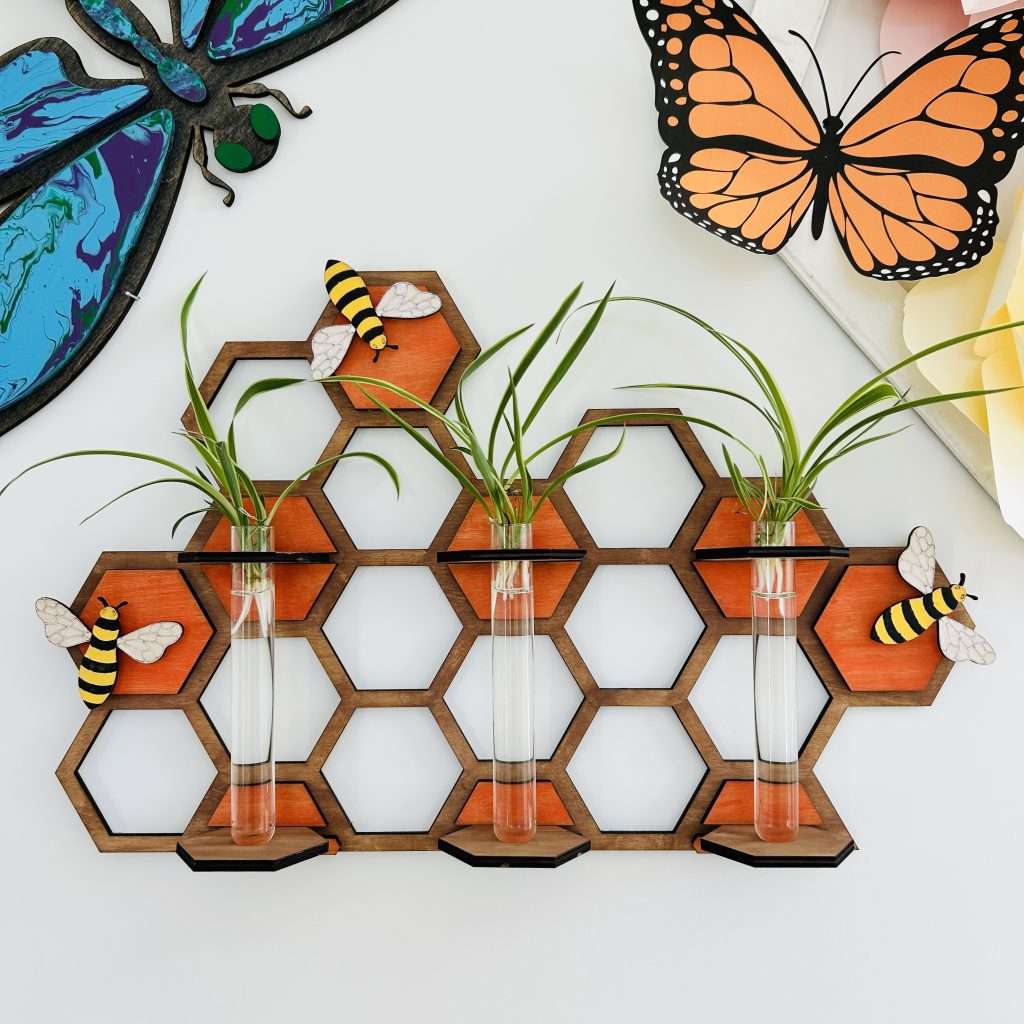
Join us for our Buzz and Grow Propagation / Flower Station Class!

Another project inspired by nature and my trip to Mexico for the Monarch Butterfly Migration.
Stencil is a mobile craft studio offering craft events in the Metro Phoenix area.